Yangon is a city defined by a jaw-dropping architectural contrast: pure gold stupas next to massive, stately colonial buildings. This blend tells the story of Myanmar. To truly get a sense of this vibrant city’s past and present, you need to see these five structures up close.
1. The Shwedagon Pagoda: The Golden Heart
This isn’t just Myanmar’s most famous landmark; it’s the country’s beating, golden heart. The Shwedagon Pagoda is a gigantic, gilded stupa that’s believed to hold relics of four previous Buddhas, including eight strands of Gautama Buddha’s hair. It actually soars about 100 metres into the sky. You can see that gold-covered spire from nearly anywhere, and it’s especially stunning illuminated at night. The main structure is wrapped in thousands of gold plates and topped with a jewelled crown, making it the ultimate display of Burmese Buddhist faith and artistry.

2. The Secretariat: A History No One Forgets
The Secretariat is a huge, imposing Victorian brick complex right in downtown Yangon. Built between 1889 and 1905, it was the administrative hub for the British colonial government. Architect Henry Hoyne-Fox definitely knew how to build big; its colossal scale and heavy Victorian design firmly established it as an imperial power icon. But its significance is truly immense: it’s the tragic and exact spot where Myanmar’s national heroes were assassinated back in 1947.
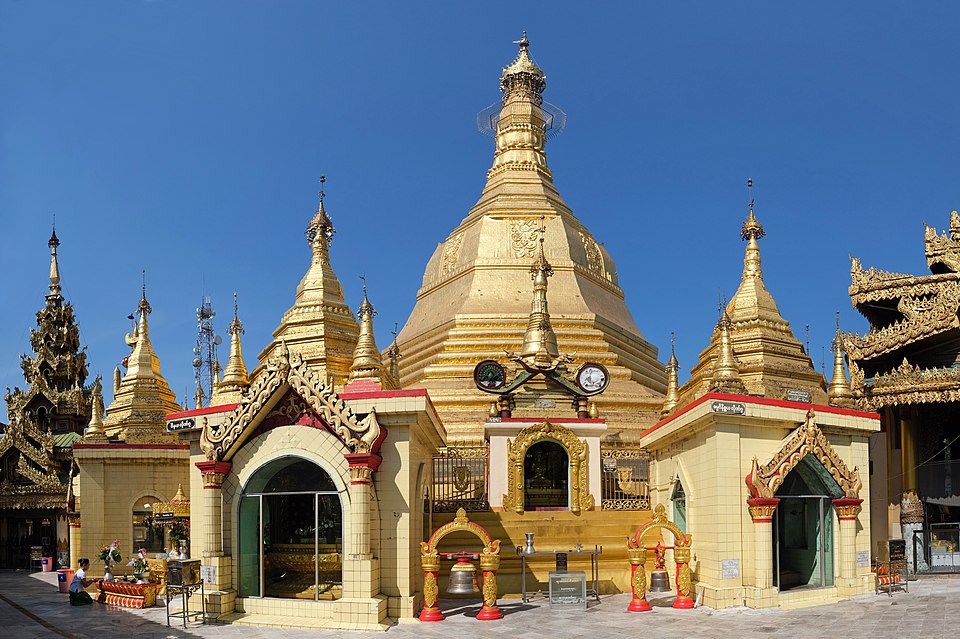
3. Sule Pagoda: The City’s Epicentre
Walk right into the absolute centre of Yangon’s downtown grid, and you’ll find the Sule Pagoda. People say it’s more than 2,500 years old, maybe even older than the Shwedagon. It’s a distinct Mon-style stupa, octagonal from the base right up to the spire. Fun fact: a British army engineer named Lieutenant Alexander Fraser used this particular pagoda as the core landmark to lay out the whole city’s street grid in the mid-19th century. Talk about a crucial piece of urban planning.
4. High Court Building: Red Brick Grandeur
The High Court Building, completed in 1911, is another striking colonial-era spot. It really stands out because of its red and yellow brick facade and that massive clock tower. James Ransome designed it in the Queen Anne style, and it perfectly captures that authoritative, powerful look the British-era judiciary favoured. It sits right near Maha Bandoola Garden, making it an unavoidable part of the downtown scenery. If you’re touring this area, you’ll be pleased to know that great accommodation is nearby. Chatrium Hotel Royal Lake Yangon, for instance, has interior decor featuring elegant, classic touches and traditional Burmese accents combined with beautiful lakeside views, and it is a top-rated Yangon hotel in Myanmar, which is just a short drive away.
Note: The building is still actively used (it’s the High Court of Yangon Region). You generally can’t go inside, but the exterior is fantastic for photos.
5. Yangon City Hall: Burmese Style in the Urban Core
Standing proudly next to the Sule Pagoda, you’ll see the Yangon City Hall. It’s a wonderful example of what happens when cultures meet. Designed by U Tin (Myanmar’s first qualified Burmese architect) and finished in 1936, the building beautifully merges traditional tiered roofs, called pyatthat, with Western forms. Look closely at the arched entrance, and you’ll spot sculptures of Nagas, the mythical serpents, guarding the hall. U Tin’s design was a powerful statement, a clear move to blend Burmese tradition and modern form, forging a new national identity during the colonial era.