
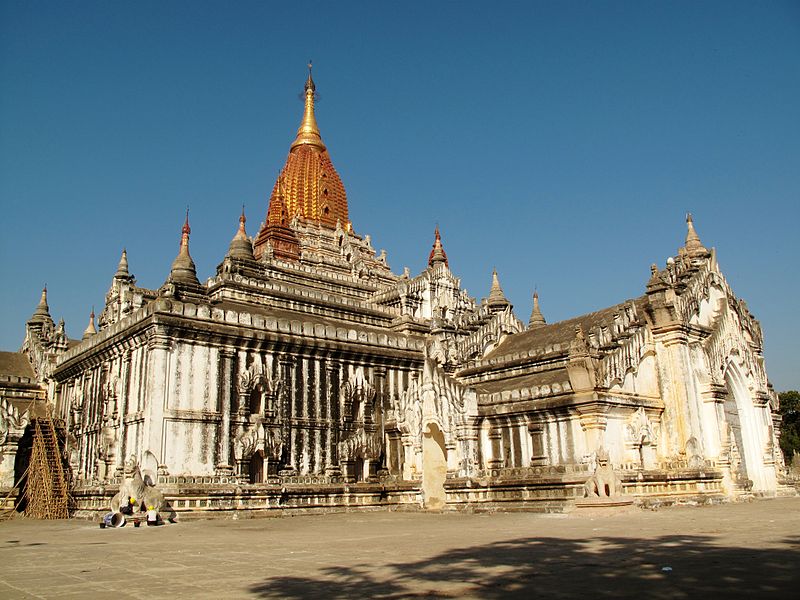
Ananda Pahto shines with its architectural design as well as its history. Said to be built in 1090 and 1105, Ananda Pahto is one of the most revered Bagan temples. There is so much to discover and explore in this much revered temple.
But you cannot access the upper floors of the temple. Apart from that, the entranceways resemble a Greek cross. When you get to the base and the terraces, you will notice the 554 glassy tiles. These tiles narrate the Jataka tales. When you look back, you can see the big teak doors. These doors divide interior halls.
When you move a little further, you can see four Buddha statues. Each of these standing statues is about 31 feet high. Two statues have the Bagan style. If you are familiar with Buddhist iconography, you will naturally get what the statue says. It is the Dhammachakka mudra which is the Buddha’s position of teaching the first sermon. The remaining two statues are relatively new as they had been built to replace the old statues. They got caught up in fire in the 1600s. There is one thing common about all the four statues. They are built in solid teak.
And if you go with a tourist guide in tow, they will share many interesting facts with you. If you stand in one side, the guides will explain, you will see the Buddha’s face in a sad mood. If you would like to have a tourist guide, seek help from any Yangon hotel such as Chatrium Hotel Royal Lake Yangon. They will assist you in finding a good guide.
The Buddha statue that faces the west has his hands stretched far. In iconography, this is called abhaya mudra (the fearless position). You will see big lacquer statues at the bottom of this statue. These two statues represent King Kyanzittha and the Theravada Buddhist monk Shin Arahan.
And before leaving the temple, remember to take a leisurely stroll around the temple. You can see more tiles and the stunning panoramic view outside the temple.
The western and eastern standing Buddha images are done in the later Konbaung, or Mandalay, style. If looked at from the right angle, the two lions at the eastern side resemble an ogre. A small, nut-like sphere held between the thumb and middle finger of the east-facing image is said to resemble a herbal pill, and may represent the Buddha offering Dhamma (Buddhist teachings) as a cure for suffering. Both arms hang at the image’s sides with hands outstretched, a mudra (hand position) unknown to traditional Buddhist sculpture outside this temple.
The west-facing buddha features the abhaya mudra (the hands outstretched, in the gesture of no fear). At its feet sit two life-sized lacquer statues, said to represent King Kyanzittha and Shin Arahan, the Mon monk who initiated Anawrahta into Theravada Buddhism. Inside the western portico are two symbols on pedestals of the buddha’s footprints.
Don’t leave without taking a brief walk around the outside of the temple, where you can see many glazed tiles and lovely views of the spires and terraced roofs (often away from vendor hassle too).
Roland Lefevre is a travel writer who specializes in creating features on leisure as well as business travel destinations across the globe. Google+





.jpg)