
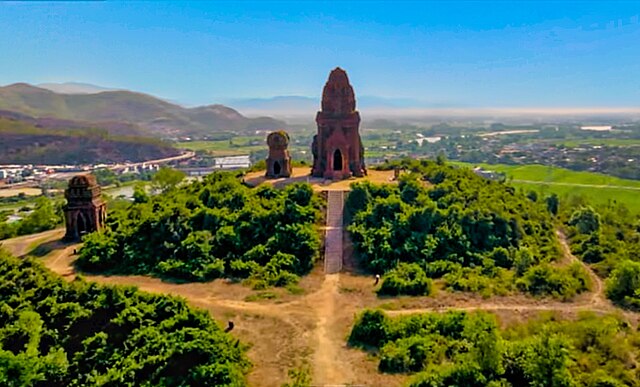
With their intricate designs, symbolic motifs, and spiritual significance, the Cham Temples in Quy Nhon offer a captivating glimpse into the region’s illustrious past, inviting visitors to embark on a journey through time and immerse themselves in the mystique of Vietnam’s cultural tapestry. These temples, dating back to the ancient Champa civilisation, are poignant remnants of a bygone era, whispering tales of a once-thriving kingdom.
A brief look at history
Between approximately 1000 and 1500, the Champa territory occupied the coastal regions of present-day southern Vietnam. Governed by the indigenous Cham people, this area was centred around Vijaya, located just north of what is now Quy Nhon, serving as the Cham capital until its defeat in 1471. During their zenith, the Cham people excelled as adept seafarers, dominating maritime trade routes connecting China, India, and Indonesia, and facilitating the exchange of silk and spices.
The Thap Doi Towers
Merely two kilometres away from the city centre, the Thap Doi Towers, also known as the ‘Twin Towers’, stand as the most easily accessible among the Cham heritage sites. Erected in the late 12th to early 13th century, these towers crafted from red brick quietly reside within a petite city park, enveloped by coconut palms, banana trees, and lush tropical flora. Side by side, the pair of towers, one towering at approximately 20 meters while the other reaches around 18 meters in height, offer a humble spectacle.

The Banh It Towers
Perched atop a hill with sweeping vistas of the surrounding countryside, the Banh It Towers comprise a group of four meticulously restored Cham towers that exude grandeur. Located approximately 15 kilometres from Quy Nhon city centre, just off Highway 1A, these towers promise to captivate any beholder. As one of the more frequented Cham sites by tourists, informative signage along the way elucidates the architectural nuances of each tower.
The Vijaya Citadel
The Vijaya Citadel, also known as Do Ban, Cha Ban, and Hoang De, holds immense significance among the Cham heritage sites. Once a thriving hub, Vijaya served as the Cham Kingdom’s capital from the 11th century until 1471, witnessing pivotal battles, sieges, and conquests that shaped the region’s history. Although Vijaya’s remnants are scant, ongoing excavations have unearthed fragments such as walls, stone lions, and square wells. If you’re staying in a nearby Quy Nhon resort, such as the Avani Quy Nhon Resort, make sure to add this to your list of places to see.